[p. 1]
AN AEROPLANE-MOTOR
CAR
[p. 2]
AN AEROPLANE-MOTOR CAR
Rene Tampier’s aeroplane-motor car marks
a new epoch in the history of aviation as it attempts to solve important
problems which may be summed up as follows:
1° Fog problem.
In case of a fog, the pilot who frequently finds that he has lost his
bearing, cannot descend where he likes; the fastest solution is for him to
try and find a high point, the nearest to his point of landing, which is
not shrouded by fog, and to land there? Up to now, the aeroplane in such
case had to stop there, but now it can get back to its landing point. [p. 3]
[p. 4] 2° Garage problem.
The possibility of leaving the house
in an aeroplane, reaching a starting ground, returning to the said place,
bringing the aeroplane back and garaging it by the side of the motor car,
opens new vistas to every one, the cost of hangar, mechanics, etc. being
eliminated.
3°
Problem of returning in case of a breakdown.
The very high cost of labour for dismantling,
placing on truck and transporting the aeroplane in case of a breakdown,
is now replaced by the low cost of returning by road.
4°
Problem of starting.
The auxiliary petrol engine makes it
possible to start at once the large engine. It does away with the necessity
of employing a mechanic for starting the propeller; it avoids moreover the
use of carbonic acid or compressed air car buoys or of accumulator batteries
difficult to keep charged in a hangar. [p. 5] [p. 6]
5° Problem of control of the
inner parts of the aeroplane.
a) In large aeroplanes, a greater force
than that of a man will be useful for keeping the aeroplane in its direction,
and it will be supplied by the small engine.
b) In the latest aeroplanes, the lighting
is supplied by a dynamo driven by the large engine. The small engine avoids
the necessity of using for that purpose part of that power of the large
engine.
c) For operating certain apparatus intended
for wireless telegraphy, photography, etc. propellers controlling the differences
of speed of the aeroplane, are something used which produce resistance to
the advance. The auxiliary engine allows a more mechanical control.
d) In case of control in the air of
an aeroplane without a pilot by another, the small engine will be supply
the necessary power.
e) In case of the use of stabilisers
of any type, the small engine could be used for operating them. [p. 7] [p. 8]
f) The forced feed of the
engines could be effected by means of a turbine driven by the small engine,
the power of which will then increased.
When flying at high altitudes, the use
of a source of power independent of that of the engines of the aeroplane,
from the point of heating, ventilation, etc. is of great value.
6°
Military problem.
a) The aeroplane-motor car can accompany
cavalry or artillery.
This aeroplane with folding wings is
more particularly valuable for the navy when it is desired to carry on board
ship aeroplane ready to fly. The starting of the large engine by an auxiliary
petrol engine is a useful on water as it is on land.
b) Squadron could be formed, capable
of moving in case of fog for instance and changing several times a day the
landing point, without it being necessary to dismantle the apparatus. Their
camouflage becomes easy, they can be concealed in the first line in ruins.
[p. 9] [p. 10]
|
|
|
|
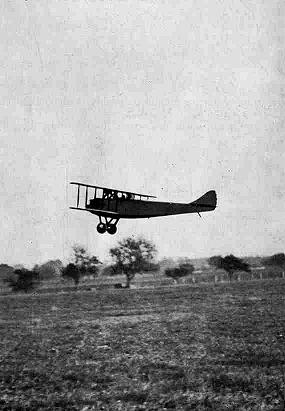
In flight at Buc.
|
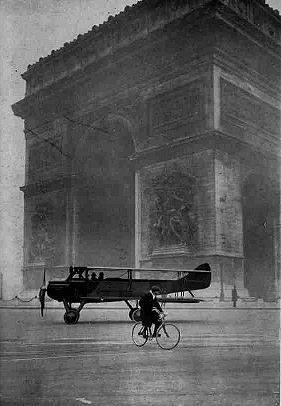
In Paris, place de l’Etoile.
|
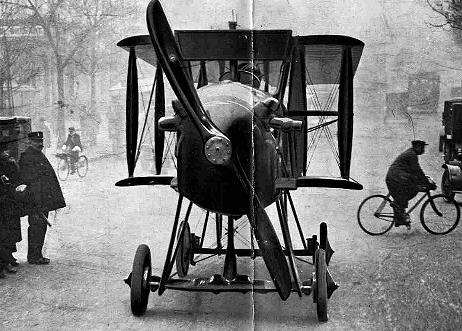
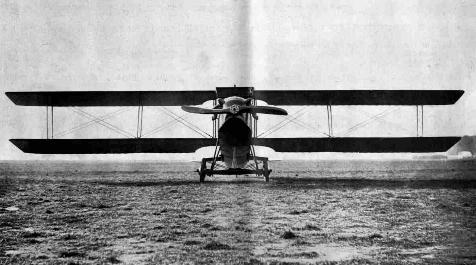 At the moment of starting from the ground.
 Avenue des Champs Elysées.
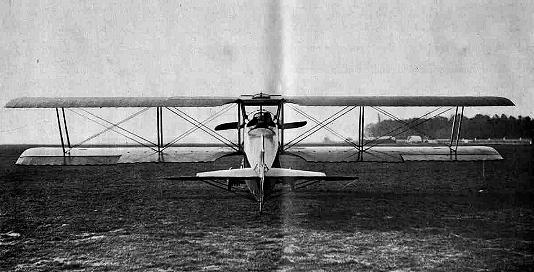 Before starting.
|
c)
An ordinary aeroplane of the size of that of Mr. Rene Tampier, requires
several hours for erecting and adjusting it ; a squadron provided with Tampier
machines is ready to fight in less than an hour. Moreover, ten aeroplanes-motor
cars cab be stored where formerly there was room only for two or three ordinary
aeroplanes.
d) The Tampier machine is easier to
manage on the road than a lorry ; it runs faster, it can start on any ploughed
ground, provided that the wheels do not skid ; it can climb any hills. It
does with hand labour, tractors, etc. required in the case of long journeys.
Machines of 10 and 15 tons can easily be moved with an auxiliary engine.
e) In large machines, the manipulation
of bombs, torpedoes, etc. can be facilitated by the use of the auxiliary
engine.
f) The controls of machine guns, guns,
etc. could depend on the small engine, and will continue then work even
in case of a breakdown of the large engine.
g) Either in the colonies or on long
journeys, the starting engine will be a more reliable means of starting [p.12] the large engine than any other device. In
case of a reconnaissance in uninhabited countries, of a breakdown or failure
of fuel required for supplying the engines which consume 20 gallons per
hour, the small engine with 2 gallons will sometimes enable the lost pilot
to find human beings. [p. 11]
[p. 12] h) The folding cell has
the advantage of not requiring a specialist for its re-erecting. A squadron
without a specialist fitter of cell, could fly after the wings have been
examined by its chief, any want of adjustment being clearly noticeable when
they are folded.
i) A whole new organization of squadron
could be provided with Rene Tampier’s machines: transport of tents, preparation
of landing ground, hangars, etc. are simplified. The chances of destruction
are reduced owing to the facility of movement of the machine, equal to that
of a car.
j) The folding Rene Tampier cell, of
excellent efficiency, can used with various bodies, even with different engines
forming families of aeroplanes that can get into a shed or travel on road.
[p. 13] [p. 14]
|
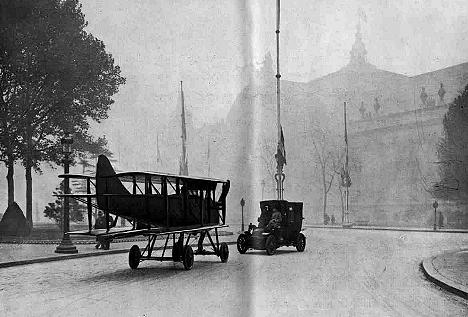 In front of the Grand Palais.
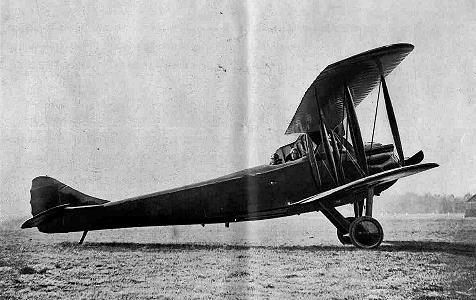 After the flight.
|
Mr. Rene
Tampier has utilized on his machine a 300 H.P. Hispano-Suiza engine provided
with the Rene Tampier feed by a pump in the tank, driven by the engine, bloctube
carburetor without a float. His experience with the feeding of aeroplane
engines has enabled him to do away with the variations due to defective carburetion,
and to carry out quickly his program.
Mr. Rene Tampier has chiefly tried to
produce an excellent aeroplane. He calls an excellent aeroplane that which
obeys at once and in an absolute manner the pilot who must not have to make
any effort for keeping his aeroplane in position, bringing it back to the
said position or inclining it.
In spite of the addition of parts which
do not exist in other aeroplane, the Rene Tampier two-seater has its masses
very close together; its controls arranged at the end of the wings or of
a light tail, are highly efficacious. Its load is less than 41 kilogs
per square meter; its small tween plane compatible with the small width of
the upper wings, makes it possible to bring the masses close together in
the vertical direction. Its great wings spread of 13 meters makes it a real
storm bird, with long and narrow wings. Mr. Rene Tampier who has been experimenting
[p.16] for three years,
in his work and in the air, with the same 300HP. Hispano-Suiza engine, provided
it with a slightly larger propeller than that generally utilized on this engine.
He has limited its speed to about 1.600 revolutions, instead of the 1850
which the 300HP. engine can give. At less than 1000 revolutions the aeroplane
without descending. The throttle open, the machine exceeding 110 miles per
hour, can resist any winds. In running order it weighs 1300 kilogs. [p. 15] [p. 16]
|
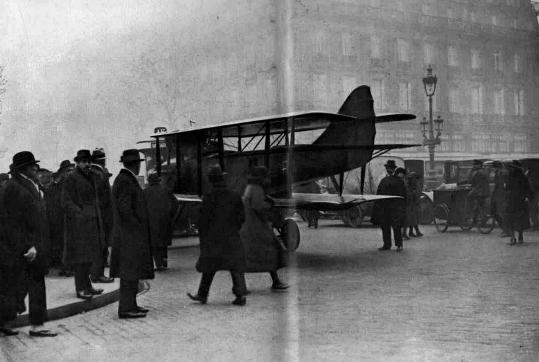 Place de l’opéra.
|
Mr. Rene
Tampier who flies as a passenger with his pilot Meyniel, can operate, on
his right, the starting magneto, on his left, the handles controlling the
small engine, the change speed levers and the brake on the differential,
the lever throwing into gear the large engine. At his feet are: on the right,
the pedal of the brake on the wheels; on the left, the pedal for declutching
the small engine. This engine is in one block with its clutch and change
speed gear; it has 4 cylinders, is water-cooled; its cooling is ensured by
the radiator of the large engine. The clutch is of multiple disc type. The
differential is secured to the landing frame. Shafts with universal joint
drive the wheels which when the aeroplane lands, are declutched and rotate
loose on their spindles. They are provided with brakes. [p. 17] [p. 18]
The steering, inclined,
by hand wheel, differs from those generally used. The axle is fixed; the
adjustable journals are controlled by the connection bar, sandows forming
spring, make it possible to move them up and down. The moving parts are
light. When flying a part of the steering gear is folded under the body of
the aeroplane, the other one, comprising the wheels, can be dismantled and
securely fixed in the machine.
On the ground, the aeroplane is a easily
managed as in the air. Having started from Buc, after two days flight, it
passed through Versailles, Boulogne sur Seine and got into the Grand Palais
on the eve of the opening of the aeronautics exhibition on the 11th November
1921. The day after closing, the aeroplane-motor car climbed Montmartre,
moved about then for two hours in Paris proving that it could climb any
gradients and move in the thickest traffic. Beautifully sprung, it exceeds
15 miles per hour.
To change from the wing spread of 13
meters in the air, to 2 meters 50 of the machine on the ground, Mr. Rene
Tampier turns each half cell about the rear mast nearest to the fuselage,
after having raised part of the lower wing, the ailerons intersect each other;
the upper wings almost touch each other. [p. 19]
[p. 20]
When the machine which has been running on the ground, is transformed in
order to fly, the steering gear can be simply folded under the fuselage,
without dismantling it; the time required for complete transformation, including
the unfolding of the wings, is then about twenty minutes.
The machine was built in Mr. Rene Tampier’s workshop, 1 , rue de Bellevue,
Boulogne sur Seine; where the following parts were machined on this machine
tools: cylinder, gear cases, differential, landing frames, etc. A work shop
has built for the first time the motor car part and the aeroplane part of
a machine.
The quick getting ready of the machine is due to the fact it is the outcome
of several years of study and of practical work placed at the disposal of
a high conscience which has carried out its idea with devotion and all the
time required.
Mr. Rene Tampier had collaborators of great value, and all their combined
efforts have produced one of the finest works ever realized in aviation. [p. 21] [p. 22]
On the 9th October 1890 a mechanical bird ridden by a man, left the ground
for the first time; it was animated by the genius of the great Frenchman,
Ader. It took possession of the air, then it descended and stopped.
It was then no longer anything but a poor thing made of wood, of metal and
canvas, a body without soul, which was moved with difficulty, whilst around
it jumped about its master : the bird.
At present, this corpse has moved; it vibrates, its heart is heard to beat;
with the wings folded, it advance, turns, goes back…
The mechanical bird is now complete.
It now knows how to use its feet.
Etampes
23rd October 1921.[p. 23]
|
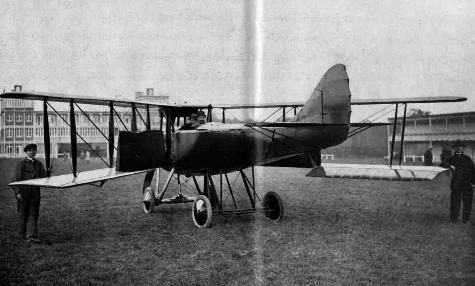 Folding the wings.
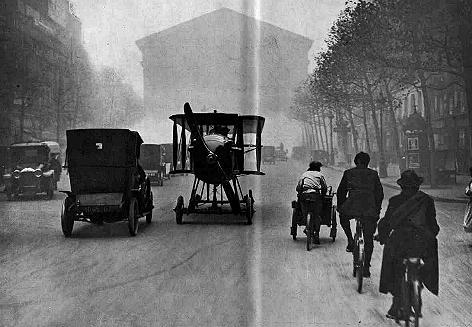 On the great boulevards.
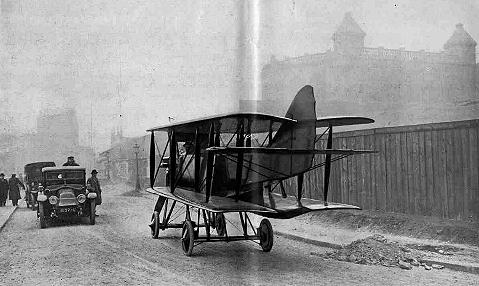 At Montmartre, after having climbed the rue Lepic.
|
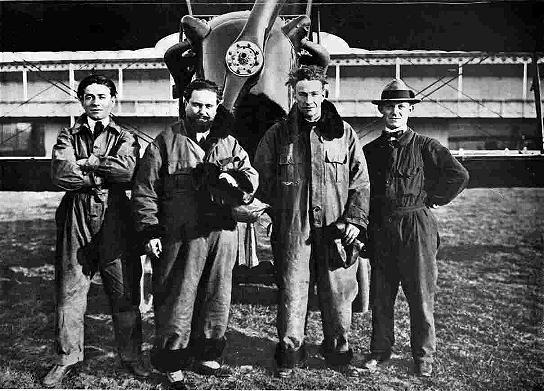
|
BIBLIOGRAPHIE
René Tampier
François JOUSSET
[éd.], «An aeroplane-motor car, made in France by René Tampier
(brochure anonyme dont la préface est datée d’Étampes)», in Corpus Étampois, http://www.corpusetampois.com/che-20-19211023tampier.html, 2001.
Autres sources
E. H. LEMONON, «L'avion-auto
René Tampier», in Les Ailes 31
(19 janvier 1922), pp. 3-4.
Depuis la mise
en ligne de cette page en 2001, la Toile a commencé à parler
un peu de René Tampier:
B. PARMENTIER, «Tampier
‘Avion automobile’ (1921, expérimental, France)» [avec
une autre photographie appartenant à la collection de Jean Michel
Ollivier], in Aviafrance, http://www.aviafrance.com/9880.htm,
2004, en ligne en 2006.
MAISONS D’AILLEURS [«Musée de la
science fiction, de l’utopie et des voyages extraordinaires» à
Yverdon-les-Bains (Suisse)], «Exposition: ‘Les voitures volantes,
souvenirs d’un futur rêvé’ à la Maison d’Ailleurs du
2 octobre 2005 au 23 avril 2006. Dossier pédagogique», http://www.ailleurs.ch/pdf/vv_dossier_p.pdf,
en ligne en 2006.
«Le
véritable pionnier du domaine des voitures volantes est l’Américain
Glenn Curtiss, qui présente en février 1917 un engin hybride
baptisé Autoplane. Mais celui-ci ne dépassant pas le stade
des modestes bonds, le projet sera très vite abandonné.
«La première véritable réussite
sera l’Avion-automobile du Français René Tampier – dont de
nombreux clichés seront publiés dans la presse de l’époque,
le montrant en train de voler puis de circuler sur les Grands Boulevards
parisiens et dans les rues de Montmartre, mêlé aux véhicules
ordinaires.»
|
PRE-WAR-CAR [«The daily Magazine & Marketplace,
dedicated to the pre 1940 car»], «Rene Tampier carburettor /
carburettors wanted, Aero bloc-tube (1910-1920)», http://www.prewarcar.com/parts/info.php?id=1857,
en ligne en 2006.
Jacques BORGÉ [d'après
le livre non publié de], «L'avion automobile de René Tampie», in Entrevoisins.org [«Le
site des aéroports franciliens pour leurs riverains»], http://www.entrevoisins.org/SiteCollectionDocuments/Fiches_histoire/1997_EV25.pdf,
en ligne en 2012.
Étampes et
l’Aviation dans le Corpus Étampois
Bernard GINESTE, «Étampes
et l’Aviation: quelques documents», in Corpus Étampois,
http://www.corpusetampois.com/index-aviation.html, 2006.
Toute critique, correction
ou contribution sera la bienvenue. Any criticism or contribution
welcome.
|